
Historically, software has been designed around the idea that users need to learn how the system works before they can use it properly. That often means training, practice and a good understanding of where different tools and functions are located.
Take reporting as an example. A user may need to know where to find the report, which fields to select, which filters to apply and how the information needs to be entered. For experienced users, this eventually becomes second nature. For new or occasional users, however, it can make even a simple task feel unnecessarily complicated.
Artificial intelligence could change that.
One of the most useful applications of AI in business software may not be replacing jobs or automating everything. It may simply make software easier and more intuitive to use.
Instead of working out which menus, fields and filters are needed, a user could simply describe what they want in plain English. The software could then interpret the request, carry out the necessary steps and return the result.
Asking the question instead of building the query
Sensor Access is currently exploring this approach within GuardPoint10 through a proof-of-concept natural-language reporting capability.
1. User makes Request
User asks question in plain language
2. AI Interpretation
AI interprets request and applies filters
3. Report Results
Report is generated by GP10
4. Save Template
The report parameters can be saved for future use
The underlying concept is straightforward. Today, an operator using the GuardPoint10 Event History can refine datasets through individual column-level filtering. While this approach is effective for many conventional reporting scenarios, certain requests may contain multiple conditions that do not correspond directly with a single report-field parameter.
For example:
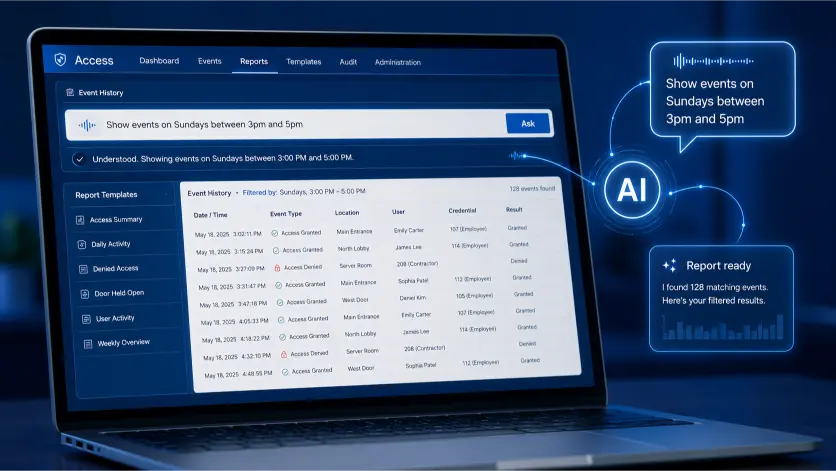
“Show me events on Sundays between 3pm and 5pm.”
Or:
“Show me cardholders whose name ends with Y.”

Both requests are simple to communicate to another person but translating those same requests into the appropriate combination of filtering parameters, may require greater familiarity with the application's existing report architecture.
The proof-of-concept therefore introduces an Ask field through which the operator can express the required result using natural language. GuardPoint10 then interprets the request and applies the appropriate conditions to the existing Event History.
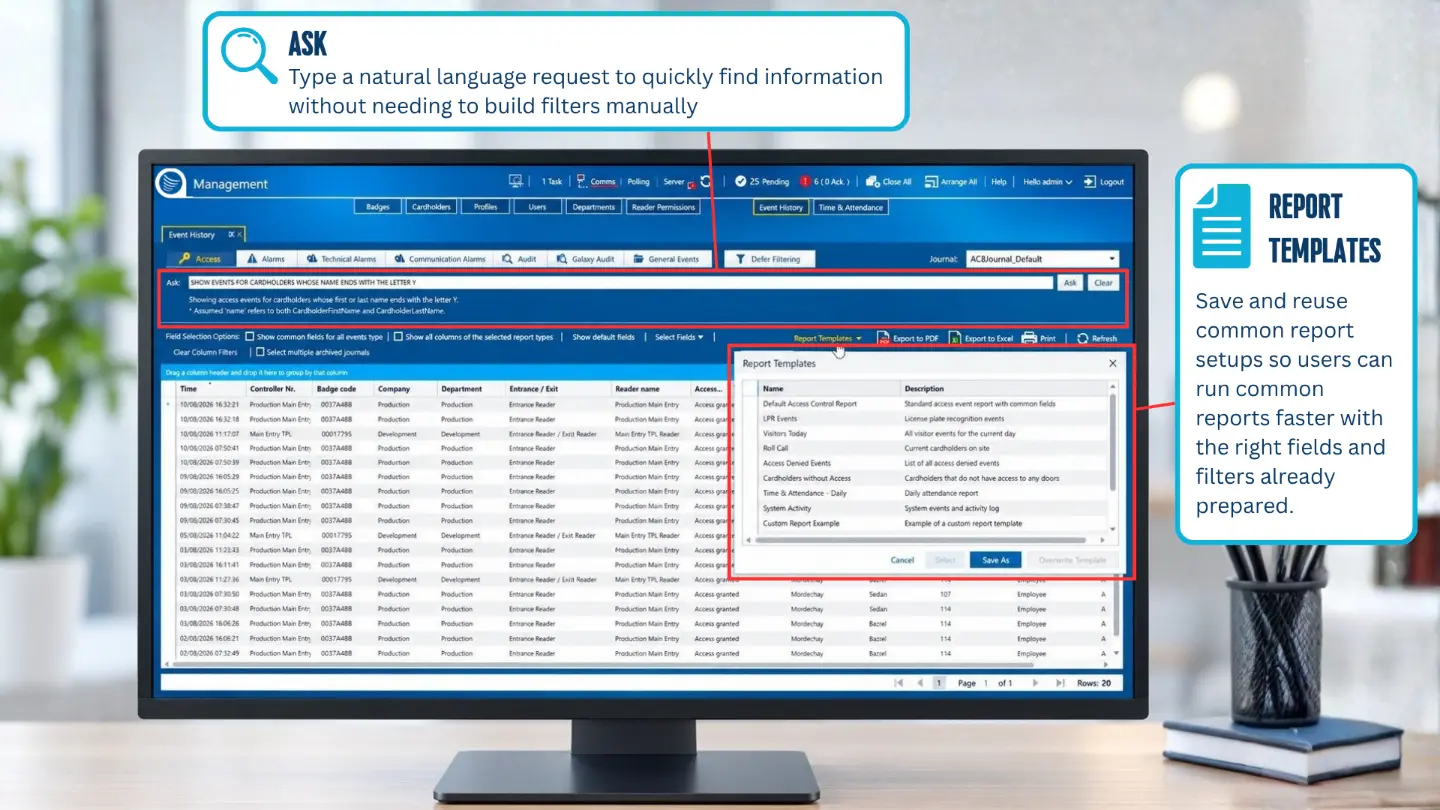
Importantly, this functionality is not intended to replace conventional reporting interface.
Operators can continue to work with the existing report interface, adjust columns, refine filters and export information to Excel or PDF using the tools they already know. Natural-language input simply provides an additional route to obtain this information.
This hybridised approach may represent a more practical application of artificial intelligence within enterprise software than replacing established interfaces entirely in favour of a general-purpose chat window.
Ensuring Interpretative transparency within AI assisted interactions
A further consideration concerns the visibility of the interpretative process itself. Where GuardPoint10 processes an operator instruction, the application can display the resulting interpretation to the operator.
For example, if an operator requests information related to an individual cardholder, the system can state how it interpreted the person’s first and last name. Where ambiguity exists, the application may also communicate the assumptions incorporated during interpretation.
This transparency is particularly critical within security-related software environments. AI shouldn’t become a black box, especially where the resulting interpretation could determine how security-event information is understood and acted on. Providing visibility of the process therefore introduces an additional verification stage through which the operator can assess whether the AI interpretation corresponds with the original intention.
Constraining artificial intelligence through clearly defined operational boundaries
There is also a big difference between using AI to interpret natural-language instructions and granting that model unrestricted access to an access-control database.
The GuardPoint10 proof-of-concept has consequently been structured around explicit limitations regarding the scope of AI interaction.
The operator's natural-language instruction can be sent to an AI service, but the associated access-control event information, cardholder data and credential identifiers are not transmitted alongside that instruction. Furthermore, the AI does not receive unrestricted capability to generate unrestricted database queries. Instead, its responsibility is confined to translating the supplied instruction into a constrained filtering condition. GP10 then checks that filter before it is used.
Where the operator requests information that cannot legitimately be derived from the available report dataset, the system can refuse the request rather than trying to invent an answer.
This represents a potentially important principle for future AI-enabled enterprise software. The aim should not be to give AI unrestricted data access or system control simply because we can. Instead, artificial intelligence can be used within narrowly defined operational boundaries where it provides clear usability improvements, without unnecessarily expanding the system's risk profile.
Ask once, then save the report
The natural-language reporting concept also introduces an additional efficiency mechanism.
Once GP10 has interpreted a natural-language request and created the filter, the operator can save it as a normal report template. After that, the report can be opened again without having to ask the AI the same question each time.
An operator could initially describe a complex reporting requirement through natural language, allow GuardPoint10 to translate the instruction into the relevant parameter configuration and subsequently save that configuration under an appropriate report identifier for future use.
Artificial intelligence therefore functions as a configuration-generation mechanism rather than necessarily remaining an intermediary with every subsequent interaction.
Will natural language interaction make conventional graphical interfaces obsolete
Not necessarily.
In many situations pressing a button will remain simply quicker.
Graphical interfaces also provide an important function in that they visually show the functionalities of the software that users may not otherwise know exists. If everything was hidden behind a prompt, this may actually make software harder to use rather than easier in some cases.
A more practical implementation is the coexistence of structured graphical interfaces and natural-language instruction.
An experienced operator familiar with the required navigation path may continue to interact directly with menus, controls and report filters.
While a less experienced user may instead enter:
“Show me all denied access events at the main entrance today.”
Despite employing different methods, both users ultimately arrive at the same outcome.
The difference is that natural-language interaction reduces the requirement for the second user to possess prior knowledge of the software's architecture.
Software that understands user intent
This shift potentially represents one of the more significant implications of artificial intelligence within enterprise software design.
Historically, software training has largely involved teaching people how the application wants them to work.
- Where is the function?
- Which menu is it under?
- Which field do I need?
- Which filters should I use?
Natural-language interfaces start to reverse that relationship.
Instead of always teaching the user how to speak the software’s language, the software can begin to understand ours.
This does not necessarily mean conventional graphical interfaces will be disappearing entirely. Structured interfaces remain valuable because they are predictable, discoverable and highly efficient for experienced users.
However, natural-language prompts and potentially voice-based interaction may increasingly become a much more normal part of using everyday business software.
Natural-language reporting within GuardPoint10 represents one potential application of this concept.
The bigger change may be that, over time, using powerful software becomes less about knowing where everything is and more about simply knowing what you want to achieve.