

Comparing Wiegand and OSDP what installers and integrators need to know
A plain guide to how OSDP compares with Wiegand for connecting readers to access control controllers, and where each one fits.
For decades, Wiegand has been the default way to connect a card reader to an access control controller. It is simple, widely supported and well understood. But it was designed for a different era, and more installers, integrators and end users are now asking about OSDP. Here is how the two compare, and what to think about when choosing between them.
How Wiegand works
Wiegand sends the card number from the reader to the controller, one way, over a set of dedicated wires. A typical installation uses 8-core 22 AWG cable (not twisted pair) back to the controller, maximum run 100 m.
It works, but it has well-known limits:
- One-way only. The controller cannot talk back to the reader.
- Card data travels in the clear, which is widely recognised across the industry as a weakness.
- More cores, shorter runs. Each reader needs its own multi-core cable back to the controller.
What OSDP changes
OSDP is an open standard from the Security Industry Association. Instead of dedicated data lines, it uses an RS-485 connection, which brings several advantages:
Two-way communication.
The controller and reader can talk to each other over RS-485.
Longer cable runs.
On 24 AWG twisted pair cable, runs of up to 1,000 m are possible, with 120 Ω termination on long runs.
Fewer cores.
OSDP needs fewer cores than Wiegand, which can simplify cabling.
Several readers on one bus.
Readers can be daisy-chained rather than each needing its own cable back to the controller.
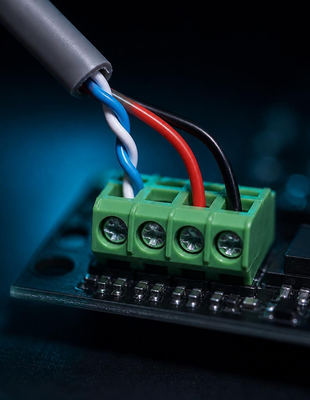
The biggest security difference between the two protocols is how the card data is protected on the cable.
The problem with Wiegand
Wiegand data is unencrypted and one-way. Anyone with access to the reader wiring, for example behind a reader on an outside wall, can fit a small, cheap device that records the card numbers passing along the cable. Those numbers can then be replayed later to open the door. Because the controller cannot talk to the reader, it has no way of knowing the line has been tapped.
OSDP Secure Channel
The OSDP standard includes Secure Channel, which protects communication between the reader and the controller:
- AES-128 encryption. Data on the cable is encrypted, so recorded traffic is not usable card data.
- Authentication. The reader and controller prove to each other that they share the same key before a secure session starts, and each message carries an authentication code, so tampered or replayed messages can be rejected.
Secure Channel is part of the OSDP standard, but not every OSDP product or installation uses it. A reader can also run OSDP in plain (unencrypted) mode. When you specify an OSDP system, check which mode each reader and controller supports and how the keys will be set up.
Pros and cons at a glance
Both protocols have their place. Here is a quick summary.
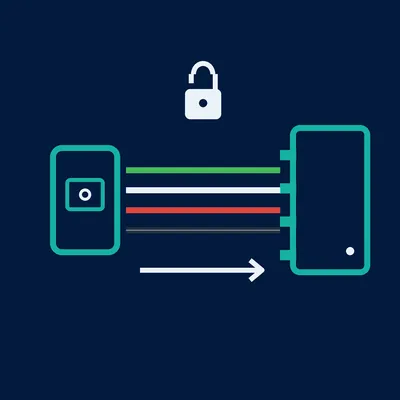
Wiegand
- Easy to implement and configure.
- Generally more affordable.
- Widespread adoption. Widely supported across readers and controllers.
- A proven track record over many years.
- One-way communication only.
- Data is unencrypted
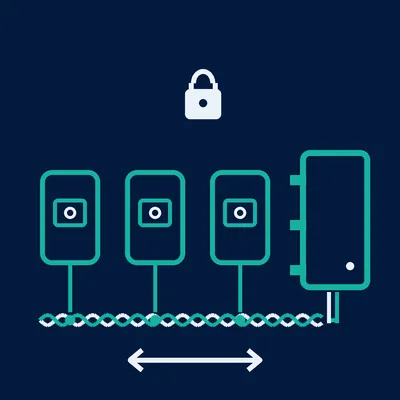
OSDP
- Two-way communication. Enables more advanced functionality
- An open standard, designed for compatibility between products.
- AES-128 encryption with Secure Channel
- Initial expenses may be higher.
- Can be more involved to implement.
- There can be some issues between different manufacturers' products.
OSDP with Sensor Access
Our QR reader is available in an OSDP version (plain mode). It works with GuardPoint10 on our IC2001 and IC4001 controllers with the OSDP option, with up to 4 readers per controller daisy-chained on one RS-485 bus. Talk to us before using third-party OSDP readers.
If you are planning an OSDP installation, talk to us first so we can confirm the controller set-up your project needs.
Which should you choose?
Wiegand remains a practical, widely compatible option, especially when you are upgrading an existing site with existing cabling. OSDP is worth considering for new installations, longer cable runs and sites where two-way reader communication matters to the customer.
Whichever you choose, always bear in mind that the overall security of a system is determined by its weakest link. For instance, if your access card, like MIFARE CSN, can be easily cloned using a mobile device, then it becomes the most vulnerable part of the system.
Talk to us
Planning a project, or want to know whether OSDP suits your customer's site? Our team can help you choose the right readers and controller set-up.